


Almost every department has adopted AI in the last 1–2 years. But not every department has adopted it the same way.
The difference comes down to three questions:
Can AI produce clear, acceptable output on its own?
What’s the cost of a human doing the same work?
What’s the risk if AI gets it wrong (legal, brand, political)?
This is why AI has got fast adoption in software programming:
AI outputs are deterministic enough
Human time is expensive
Risk is relatively low
No wonder, the upside is obvious and we have seen massive adoption curves.
Recruiting is fundamentally different
Recruiting isn’t one job. It’s a bundle of very different tasks—each with different risk and economics.
AI does create clear value in some areas (resume screening, high-volume screening calls, initial shortlisting)
Human ops cost is relatively low (often ~¼ of software engineering cost)
The downside risk is much higher (bias, compliance, employer brand, candidate experience)
So TA leaders are cautious. That’s rational.
How AI is actually getting adopted in recruiting?
At Cutshort, we talk to a lot of TA heads (~20 every week).
What we’re seeing in the market is:
Point tools that use AI for one task at scale (search, screening, outreach)
Or services that abstract AI away and deliver outcomes (so teams get benefits without owning risk like Cutshort for sourcing)
The “wait and watch” trap
While TA heads are no longer cynical about AI, many still have a “wait and watch” kind of outlook. They are thinking more like:
“Just let AI play out. 20% productivity gain in 12-18 months time frame is fine.”
This is understandable. But here is the real downside:
“By playing conservative, TA heads are losing a chance to solve long-standing challenges they could never address before”
This should make it clear:
Across different departments, the most valuable impact of AI is not the productivity gain. It’s the agility and impact.
In software development, Cursor frees up time from writing code to thinking about business problems. They ship faster and learn faster from the market. Productivity gain is nice added benefit.
The same shift is possible in recruiting
Similarly in recruiting, there are TA leaders who are adopting AI not to reduce people cost but to fix the longstanding issues in their recruitment process for which they never got time earlier.
closing candidates
improving joining ratios
strengthening employer brand
making hiring data-driven
This post from Rishi Banerjee is a great example of this:
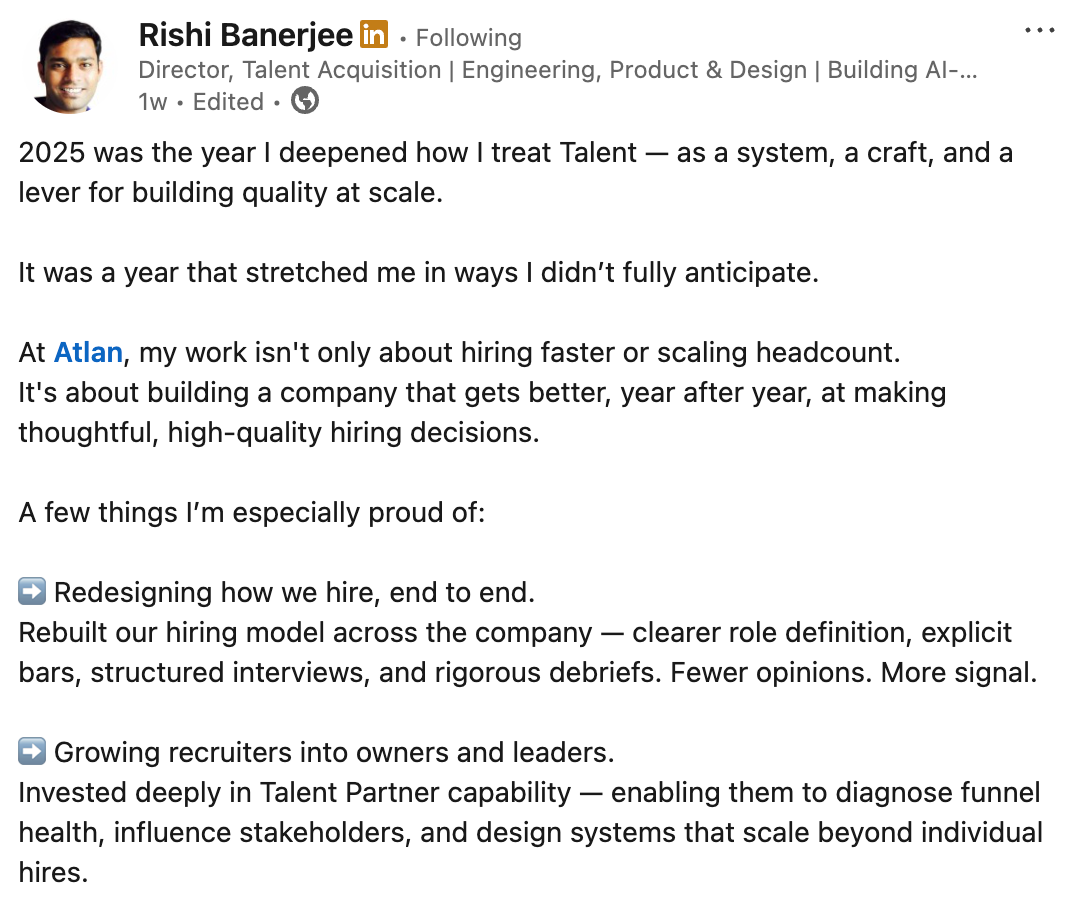
Rishi is not alone. In our conversations, some 10% of TA leaders get super excited about how our 3.5% only-sourcing model can do the sourcing while their team could focus on closing and other high impact work.
TLDR: The best TA leaders are not being reactive - they are freeing up their time to make their roles and teams more strategic than ever before.
Your recruiting team stuck in manual work?
If your recruiting team is buried in manual sourcing, nothing is “broken.” Offers per recruiter may look fine for the salaries you pay.
But imagine this instead:
A smaller, sharper TA team
Less time on resume submissions
More time fixing problems you’ve postponed forever
That’s what the best TA leaders are doing with AI—not reacting, but reclaiming their time to become strategic again.
P.S. If you want to free your team from manual sourcing for product/engineering roles, check out Cutshort.ai.
