


Will AI Really Kill Jobs?
Most people believe so. They look at layoffs and media headlines. And yes — their own experience confirms that tasks which took them days now take minutes with AI.
So the conclusion feels obvious: “AI will replace us.”
But this is a paradox. The story starts in the 1800s.
Meet Jevons Paradox
In 1800,s William Jevons studied something strange:
When steam engines became more efficient, people didn’t use less coal. They used more.
Why? Because efficiency made coal:
cheaper
easier to use
economically viable for new industries
Result: total coal consumption skyrocketed.
This became Jevons Paradox —
when the cost of something drops drastically, total demand usually explodes.
Jevons paradox applied in software engineering
AI has dramatically reduced the cost of coding. Non-engineers are now building tools and products that earlier required a full engineering team.
So at first glance, it looks like software engineering jobs will be decimated.
But let’s apply Jevons properly.
1. AI reduces the cost of software development
What needed 10 engineers may now need 3. A prototype that took 3 months now takes 3 days.
Anyone looking only at this step concludes: “AI kills jobs.” But they’re missing the second half of Jevons.
2. Lower cost → More projects → More demand for people
When something becomes dramatically cheaper, it opens the door for:
new customer segments
new use cases
new industries
entirely new categories of products
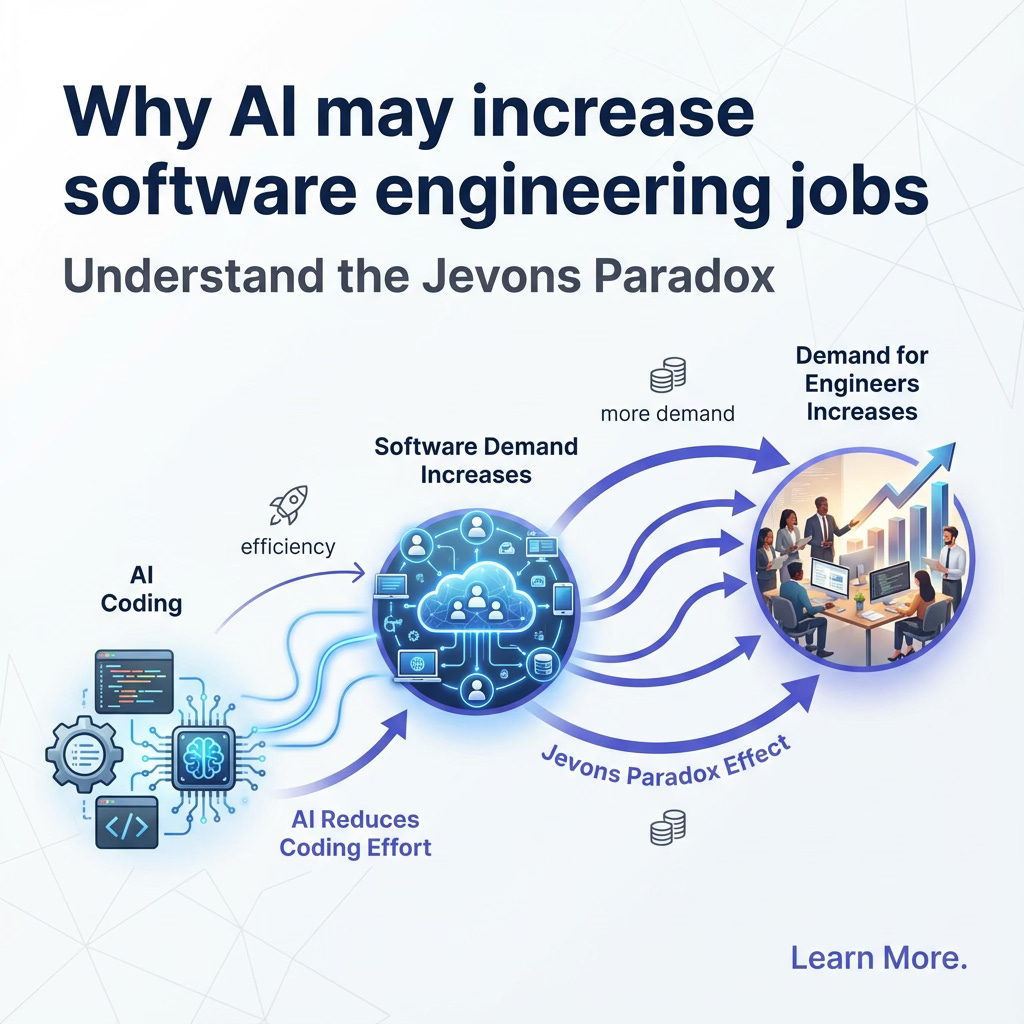
And we’re already seeing this play out.
We’re watching this in real time
Modern AI-first companies are hitting $100M ARR in months, not years. Why? Because:
Small businesses that never bought software tools before… now buy AI tools.
Non-technical teams that never hired engineers… now launch internal tools using AI.
Founders who earlier struggled with MVP costs… now build faster and hire instead for operations, customer success, partnerships, and domain expertise.
The market didn’t shrink.
It exploded.
“But won’t fewer engineers be needed?” Yes… per project. But more projects will be commissioned than ever before.
This is the part most people miss.
A typical company might cut engineering headcount per initiative — but will also launch more initiatives because it’s now economically feasible.
If building a tool goes from:
₹1 crore → ₹10 lakhs
6 months → 6 days
Why would a company build one tool? They will build twenty.
So while the cost per project drops, the number of projects goes up even faster.
Just like Jevons predicted.
AI is going to change the type of jobs, not the number
The layoffs and hiring freezes are a short term effect. Companies are rethinking the skills they need from humans.
The shift looks like this:
↓ Pure coding
Routine engineering work becomes automated.
↑ Problem framing, architecture, and ownership
Companies need people who can:
define what to build
ensure correctness
integrate domain knowledge
manage ambiguity
run faster, cheaper experiments
New hybrid roles are already emerging
AI Engineers
AI Product Leads
Prompt Engineers (but the real kind, not the meme version)
Domain experts who can translate business problems into workflows
This mirrors every historical wave of automation — workers move up the value chain.
Just like computers changed the skill sets across almost all the job functions.
Remember the cashiers in banks? Counting notes accurately used to be an art - but it faded away when automated counting machines arrived.
Is it different this time around?
A common argument is that AI is fundamentally different. That it’s not a tool, it is the worker.
While I understand how disruptive AI is, here is my take.
Firstly, after 3 years of applying AI across several industries and job functions, we have learned that AI is not able to replace a human 100%. In some roles, it does 30%, in others it may do 85%. Despite the best of coding models, average productivity gain reported by engineering teams is just 30%, not 300%.
Secondly, even when AI acts as a complete “worker” in one function, Jevons still holds. An AI worker still needs:
product guidance
domain context
data ops
evaluation
customer understanding
integration with the rest of the business
So, net demand for humans only increases due to lower cost of running the project. (Unless we reach a point when AI scores a 100/100 on skills, business context and winning trust of humans.)
Would love to hear your thoughts.
Will Jevons paradox continue to hold or will AI defy it?