


When discussing Naukri.com, one thing that most recruitment leaders say this:
It’s expensive
It hasn’t innovated enough
The experience feels dated
And yet—
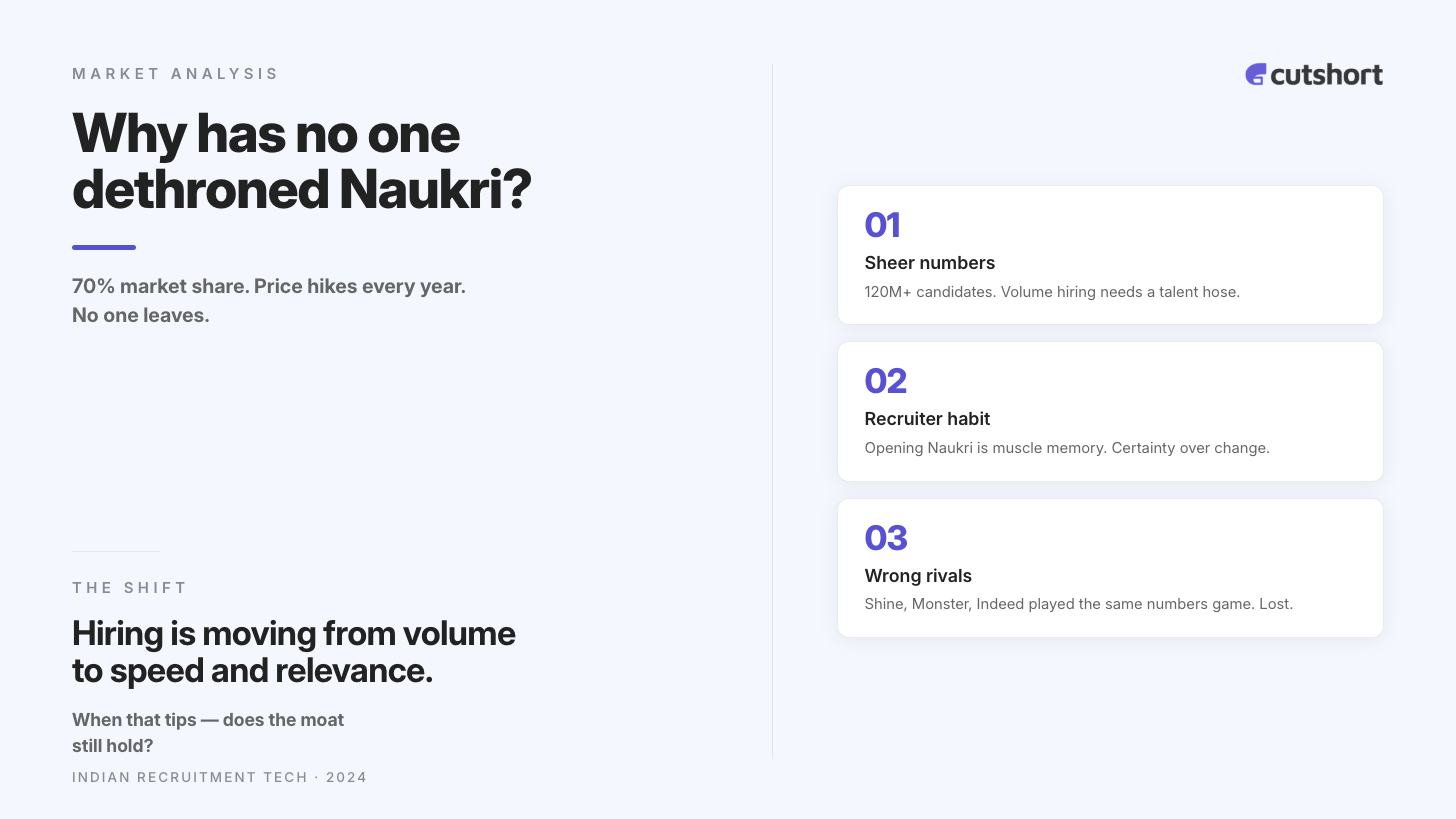
70% market share. Price hikes every year. No real churn.
So what’s really going on?
1. Naukri didn’t offer best features, but it offered what recruiting needs: predictability.
If you needed to hire at scale, there was no real decision to make. Companies needed:
A large candidate pool
Immediate access
Predictable volume
Naukri became the default because it solved one thing extremely well:
It has been the talent hose. The fattest one.
You could push thousands of candidates into your funnel and reliably get hires out the other end. Not efficient. Not elegant. But it worked.
2. Recruiters are used to Naukri
Opening Naukri every morning is muscle memory for recruiters. They were trained on it. They know how to navigate it. They know its strengths and weaknesses and.. the hacks.
And here’s the real truth in recruiting:
Recruiters have urgent targets. 10 profiles by today. 3 hires by end of the week.
Naukri delivers them the peace of mind that new platforms with shiny new features just can’t.
This is the reason why even the best products didn’t get the chance to fight.
3. Competitors chose a wrong strategy to compete with Naukri
Most challengers assumed recruiters wanted a better Naukri.
They didn't.
Recruiters wanted hiring outcomes but competitors just tried to beat Naukri on resumes.
Competitor Strategy
Monster More resumes
Shine More resumes
Indeed More resumes
Everyone fought over database size. Nobody changed how
Why the market is changing
The hiring problem has shifted.
Example 1: GCC hiring
A GCC opening 50 engineering roles today doesn't struggle to find applicants.
They get thousands of applications in a week. The bottleneck is:
screening
prioritization
recruiter bandwidth
Example 2: Product startups
A Series B startup hiring a Senior Backend Engineer may get:
300 applicants
250 irrelevant
30 borderline
20 worth talking to
The challenge is not sourcing. It's signal extraction.
Example 3: AI hiring
For AI Engineers, ML Engineers, Staff Engineers, etc. Many candidates look similar on paper. The challenge becomes:
Who should I talk to first?
Not:
Where can I find candidates?
The opportunity for recruiting platforms
The old world
Recruiter effort → candidate volume → hires
The new world
Recruiter effort → candidate prioritization → hires
Winning platforms will:
understand job requirements
evaluate candidates
rank candidates
identify intent
help recruiters spend time where it matters
The value shifts from:
Access to candidates
to
Confidence on who to engage first
So, will we see a real Naukri competitor?
The market has shifted. The new winner could be a new platform or it could be Naukri itself, if it reinvents itself.
But the new winner won't look like Naukri. The next dominant platform in Indian recruiting won't win by building a bigger database. That’s not the biggest asset anymore.
It will win by making recruiters dramatically more effective — helping them spend less time on noise and more time closing the right people.
The moat won't be candidate volume. It will be outcome reliability.
When a recruiter can trust that the top 10 candidates on their list are genuinely worth a call — and that trust holds up consistently — that platform becomes the new default.
How Cutshort approaches this
Cutshort uses AI-assisted candidate evaluation and recruiter workflows to help teams focus on the highest-priority candidates first.
Instead of reviewing hundreds of profiles, recruiters receive a prioritized shortlist based on role fit, intent, and hiring requirements.
This is so true. I always wondered why is Naukri the default choice for recruiters? Even LinkedIn. I could never see an ROI on LinkedIn, neither a recruiter nor a job applicant. Recruiters still keep wondering why they are not getting the right talent, and job applicants say they are not getting hired. Something somewhere is still broken.